
The Indian economy is expected to grow around 10 per cent during the current financial year on the likelihood of fewer COVID-19-linked supply disruptions and buoyancy in the global economy, said Poonam Gupta, director general of economic think-tank NCAER. The real challenge, however, would be to sustain a growth rate of 7-8 per cent in years to come, she said. "We could see annual growth in the ballpark range of about 10 per cent. "The reasons for this perceived optimism are: fewer supply disruptions; increased pent-up demand in the traditional and contact-intensive services; and a buoyant global economy.

'This is happening regardless of the Budget.'
India needs to revive corporate sector investment, push critical reforms and remove infrastructural bottlenecks to boost industrial growth in the country, says a government document.
.jpg)
RBI is scheduled to unveil its credit policy on June 3.

'The most important priority for the next 25 years should be to strengthen our democracy so that it is supportive of social harmony, and to not just respect but to take pride in the diversity of Indian society in terms of the variety of languages, religion and religious practices and social norms,' explains Nitin Desai.
Subramanian was the Dennis Weatherstone Senior Fellow at the Peterson Institute for International Economics and Senior Fellow at the Centre for Global Development in the US before joining the ministry.

There will be no second term for President Kovind and no elevation for Vice President Naidu.

China and India evoked the highest levels of confidence among major economies at 45 per cent and 40 per cent, respectively. The US was at 36 per cent, Canada at 27 per cent, the UK at 26 per cent, Germany at 20 per cent, France 18 per cent, and Japan having the least optimistic CEOs with only 11 per cent very confident of growing revenues in 2020.

'With Trump, the relationship was very transactional, whereas with President Biden it is very structured.'

In Jharkhand, the company is hopeful of starting work as soon as the mines issue is resolved, while in Orissa, consultants for the detailed project report (DPR) and the socio-economic survey have been appointed.
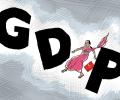
India's economy continues to be robust, but downside risks such as rising crude oil prices, adverse weather conditions, and the global banking crisis outweigh the upside potential in gross domestic product (GDP) growth in the current financial year (FY24), the finance ministry said on Tuesday in its Monthly Economic Review for March. "We reiterate that downside risks to our official forecast of 6.5 per cent for real GDP growth in FY24 dominate upside risks," the review said. "Opec's surprise production cut has seen oil prices rise in April, off their lows of low-seventies per barrel in March.

The Indian services sector activity fell to a six-month low in September, as new business inflows rose at the slowest rates since March, amid inflationary pressures and competitive conditions, a monthly survey said. The seasonally adjusted S&P Global India Services PMI Business Activity Index fell to 54.3 in September, from 57.2 in August, highlighting the weakest rate of expansion since March. For the fourteenth straight month, the services sector witnessed an expansion in output. In Purchasing Managers' Index (PMI) parlance, a print above 50 means expansion, while a score below 50 denotes contraction.

Government's focus on infrastructure is the biggest positive for the Indian economy, followed by the improvement in tax collections and good consumption recovery.

The prime minister's August 15 address was undoubtedly inspirational and outlined important economic and social objectives, such as making India a global hub for manufacturing, ensuring bank accounts for all poor families, major thrusts in sanitation and cleanliness, and a radical restructuring of the Planning Commission.

His interaction was webcast live on Twitter.

India's manufacturing sector activities moderated in December but output remained in the growth territory, amid slower rise in sales and new orders, even as business sentiment was dampened by concerns surrounding supply-chain disruptions, COVID-19 and inflationary pressures, a monthly survey said on Monday. The seasonally adjusted IHS Markit India Manufacturing Purchasing Managers' Index (PMI) eased to 55.5 in December, from November's ten-month high of 57.6. The December data pointed to a "substantial, albeit slower, rises in sales and output", the survey said, adding that the latest quarterly reading was at 56.3, its highest since the final quarter of fiscal year 2020/21.

Major General S C N Jatar, who passed into the ages on Monday night, thwarted anti-national forces at the peak of the Assam agitation. Colonel Anil A Athale (retd) salutes this officer and gentleman.

The government on Friday refrained from releasing the caste-based data in its first Socio Economic and Caste Census released in eight decades and maintained that it was concerned with economic data which will help in effective implementation of its programmes.
India's manufacturing sector activity moderated in January amid slower increase in total sales, and headcounts were broadly unchanged amid sufficient staff numbers to cope with current requirements, according to a monthly survey. The seasonally adjusted S&P Global India Manufacturing Purchasing Managers' Index (PMI) fell from December's recent high of 57.8 to 55.4 in January, as factory orders and production rose at sharp, albeit slower, rate. The January PMI data pointed to an improvement in overall operating conditions for the 19th straight month.
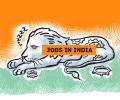
'If the 7 million estimate is true, then either our understanding of the past was all wrong or the economy has changed dramatically but so surreptitiously that we did not even notice it,' says Mahesh Vyas.

'The government is sincerely working on employment generation. Unfortunately, they are depending on these people from Harvard. Their wrong policies are killing jobs. The government has to come out of the Western framework on which they depend upon a lot.'

Manufacturing activities in India eased marginally in September but remained in good shape amid companies hiring more workers and cooling price pressures, according to a monthly survey released on Monday. The seasonally adjusted S&P Global India Manufacturing Purchasing Managers' Index (PMI) indicated a strong improvement in the health of the Indian manufacturing industry, as companies stepped up production in tandem with a sustained increase in new work intakes. The PMI at 55.1 in September continued to be in expansion mode for the 15th consecutive month but was slightly lower than 56.2 recorded in August.

The size of India's middle class will nearly double to 61 per cent of its total population by 2047, from 31 per cent in 2020-21, as continuing political stability and economic reforms with a sustained annual growth rate of between 6 per cent and 7 per cent over the next two and half decades will make the country one of the largest markets in the world. The findings are part of a report released on Wednesday by the People Research on India's Consumer Economy (PRICE) and India's Citizen Environment, a not-for-profit think tank. The report titled, The Rise of India's Middle Class, is based on an analysis of primary data collected by PRICE through its pan-Indian survey.

India's services sector activity expanded at the second-fastest pace in more than a decade during November, driven by sustained rise in new work and improvement in market conditions, a monthly survey said on Friday. The seasonally adjusted India Services Business Activity Index was at 58.1 in November, fractionally down from 58.4 in October. The November figure points to the second-fastest rise in output since July 2011. For the fourth straight month, the services sector witnessed an expansion in output.

If the prime minister says clearly there is going to be no NRC and that the Census will drop the NPR questions, the Census will proceed. He will not, observes Aakar Patel.

'They have started becoming an important player, but not at the same level as they were in the earlier part of the decade.'

The pandemic has changed the way people see the government. It has eroded trust in the administration's ability to tackle a crisis, any crisis, observes Devangshu Datta.

For the Mizo people, tribal and family identity are important. But so are jobs, farmers' access to markets, roads, and health facilities for a young population where drugs are a big affliction.

'Planning for the transfer of assets to the next generation is an important aspect of financial and estate planning.'

Market hopes govt will hike capital expenditure.

Privatisation or consolidation into half a dozen large banks might not rescue public sector banks from the crisis they find themselves in.

India's manufacturing sector activities moderated in March with companies reporting softer expansions in new orders and production as inflation concerns dampened business confidence, a monthly survey said on Monday. The seasonally-adjusted S&P Global India Manufacturing Purchasing Managers' Index (PMI) was at 54.0 in March, down from 54.9 in February, highlighting weakest rate of growth in terms of production and sales since September 2021. The March PMI data pointed to an improvement in overall operating conditions for the ninth straight month.
Undeterred by the economic downturn, average online spending by consumers in India rose by 42 per cent to $3,442 in the fourth quarter of 2008 over the preceding quarter, a survey has said.

These airports are those at Amritsar, Varanasi, Bhubaneswar, Indore, Raipur and Trichy.
India's manufacturing sector activities eased slightly in February but firms were upbeat as they responded to increased new work intakes by stepping up production and purchasing activities, a monthly survey said on Monday. The seasonally-adjusted IHS Markit India Manufacturing Purchasing Managers' Index (PMI) fell marginally to 57.5 in February from 57.7 in January, indicating that even though the pace of growth eased from January it remained sharp in the context of historical data. The headline figure for February remained above its long-run average of 53.6, the survey noted. In PMI parlance, a print above 50 means expansion while a score below 50 denotes contraction.
India's manufacturing sector growth steadied in May, with new orders and production increasing at similar rates to those registered in the previous month, while demand showed signs of resilience and improved further in spite of another uptick in selling prices, a monthly survey said on Wednesday. The seasonally adjusted S&P Global India Manufacturing Purchasing Managers' Index (PMI) stood at 54.6 in May, little changed from 54.7 in April, pointing to a sustained recovery across the sector. The May PMI data pointed to an improvement in overall operating conditions for the eleventh straight month.
India's services sector activity witnessed a sharp upturn in August on the back of stronger gains in new business, ongoing improvements in demand conditions and job creation, a monthly survey said on Monday. The seasonally adjusted S&P Global India Services PMI Business Activity Index rose from July's four-month low of 55.5 to 57.2 in August, amid a quicker upturn in business activity and the sharpest rise in employment for over 14 years. For the thirteenth straight month, the services sector witnessed an expansion in output.
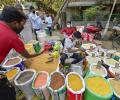
India's consumer price index (CPI)-based inflation could ease in the coming months thanks to the arrival of kharif crops, lower international commodity prices, and a pass through of lower input costs to consumers, the finance ministry said in its Monthly Economic Review (MER) for October, which was released on Thursday. The MER, however, warned that the global macroeconomic situation remained precarious and a recession in many advanced economies would impact India's exports. "Easing international commodity prices and new Kharif arrival are set to dampen inflationary pressures in the coming months.

The hype surrounding the Budget gives it undue importance.

These are valuable suggestions and one hopes the Budget will make a start on that.
 © 2026 Rediff.com - Advertise with us - Disclaimer - Privacy Policy - Sitemap - Feedback - About us - Terms of use - Grievances